
Why Smart Irrigation Technology is Poised for
Rapid Growth in North America
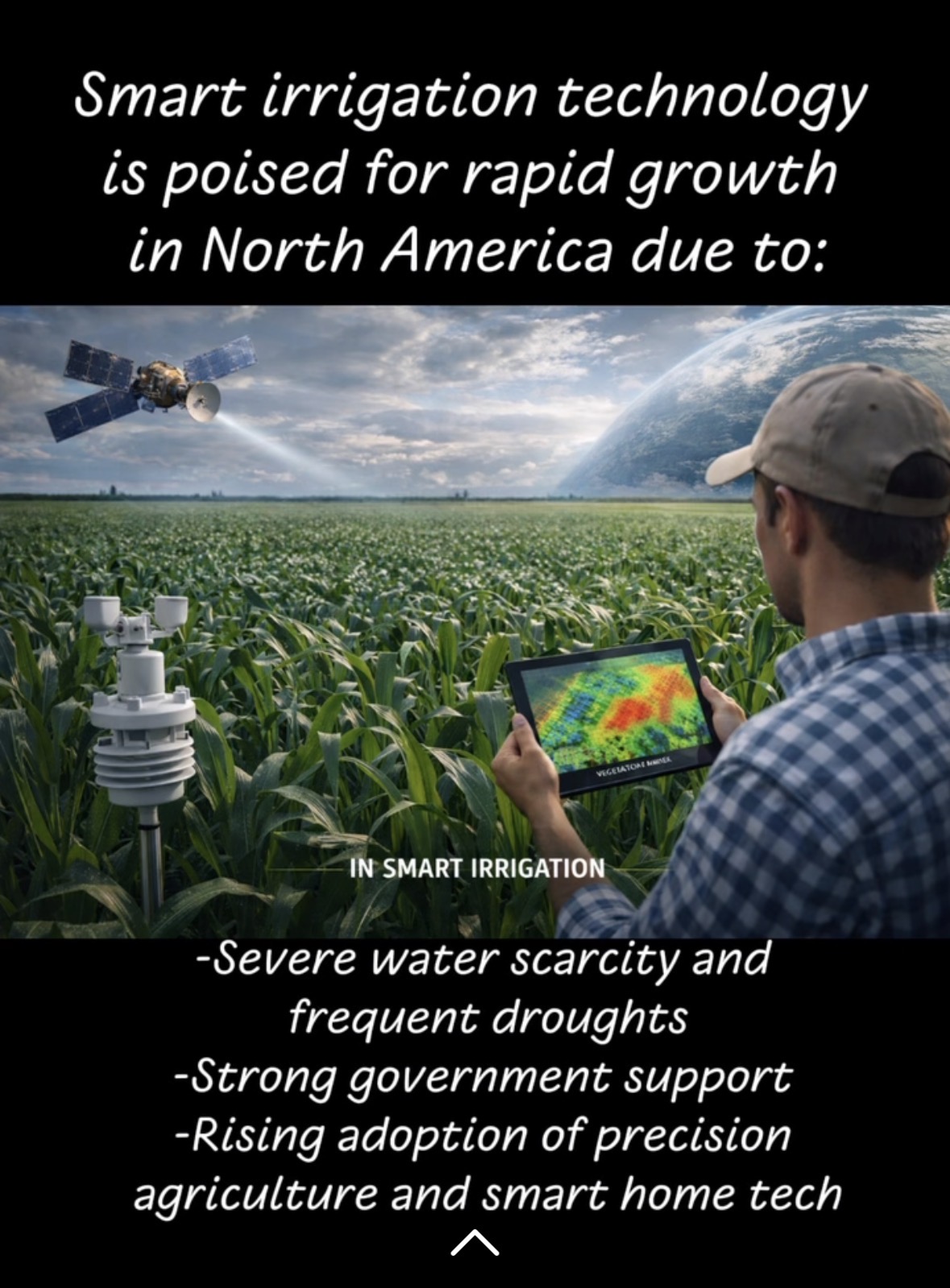
In an era defined by climate uncertainty, water scarcity, and the imperative for sustainable food production, smart irrigation technology stands as a beacon of innovation for North American agriculture. This advanced approach, integrating Internet of Things (IoT) sensors, artificial intelligence (AI), satellite imagery, and automated controls—promises to revolutionize how farmers and landscapers manage water resources. Recent industry projections indicate explosive growth in the smart irrigation market, driven by technological advancements, policy incentives, and pressing environmental challenges. Drawing from cutting-edge research at leading universities in Canada and the United States, this article explores the trends shaping the smart irrigation landscape from 2025 to 2032, with a focus on why North America is at the forefront of this transformation.
Smart irrigation systems go beyond traditional methods by using real-time data to deliver water precisely when and where it’s needed, minimizing waste and maximizing efficiency. In North America, where agriculture accounts for approximately 80% of freshwater consumption in some regions, these technologies are not just tools—they are necessities. As droughts become more frequent and water regulations tighten, the adoption of smart irrigation is accelerating. Market analyses forecast significant expansion, fueled by investments in precision agriculture and a shift toward data-driven farming practices.
Market Growth Projections: A Surge in Demand
The smart irrigation market in North America is on the cusp of rapid expansion, with global forecasts reflecting strong regional contributions. According to Markets, the global smart irrigation market is projected to grow from USD 1.59 billion in 2025 to USD 2.65 billion by 2030, at a compound annual growth rate (CAGR) of 10.8%. North America is expected to dominate with approximately 41.8% of the market share in 2025, driven by widespread adoption in the United States and Canada. This growth is attributed to the integration of AI and IoT, which enhance system efficiency and address water scarcity.
SNS Insider reports the global smart irrigation market at USD 1.59 billion in 2023, expected to hit USD 4.86 billion by 2032 at a CAGR of 13.22%, with North America commanding 40% in 2023. P&S Intelligence values the market at USD 1.8 billion in 2024, forecasting USD 4.4 billion by 2032 at a CAGR of 12.4%, with North America at 40%. Stellar Market Research projects USD 2.27 billion in 2024 to USD 5.92 billion by 2032 at 12.7% CAGR, while Data Intelligence sees USD 8.11 billion by 2032 at 18.4% CAGR, with North America at 45.34%.
Business Intelligence estimates USD 1.68 billion in 2024 to USD 4.49 billion by 2032 at 13.1% CAGR, with North America at USD 0.56 billion in 2024. Intel Market Research focuses on smart sprinkler systems, projecting USD 207 million in 2025 to USD 277 million by 2032 at 5.1% CAGR, with North America over 60%.
These projections underscore a market propelled by innovation and necessity. In North America, the U.S. and Canada are key drivers, with farmers investing in precision irrigation to combat water scarcity. University research plays a pivotal role, as seen in studies from Michigan State University (USA) and the University of Guelph (Canada), which highlight AI and IoT’s impact on yield improvement and resource conservation.
Key Drivers: Water Scarcity, Policy Incentives, and Sustainability
Water scarcity is a primary driver of smart irrigation adoption in North America. The U.S. Geological Survey reports that agriculture uses 80% of the nation’s consumptive water, with regions like California facing chronic droughts. In Canada, the Prairies and Okanagan Valley experience similar challenges, where irrigation accounts for 70% of water use in some areas. Research from the University of California, Davis, shows that smart irrigation can reduce water consumption by 20–50% while maintaining or increasing crop yields.
Policy incentives amplify this trend. In the U.S., the USDA’s Natural Resources Conservation Service (NRCS) offers funding for smart irrigation through programs like the Environmental Quality Incentives Program (EQIP), covering up to 75% of costs for sensor-based systems. California’s Sustainable Groundwater Management Act mandates water-efficient technologies, with rebates for smart controllers. Canada’s Agricultural Climate Solutions program provides grants for precision agriculture, including IoT irrigation, as noted in studies from Agriculture and Agri-Food Canada.
University-led research validates these drivers. At Michigan State University, Dr. Younsuk Dong’s work on AI for precision irrigation demonstrates 25% water savings in Midwest corn fields. The University of Guelph’s Ontario Agricultural College has shown that satellite-based monitoring reduces over-irrigation by 30% in Ontario vineyards. Water scarcity exacerbates these needs; the U.S. EPA estimates 40 states will face shortages by 2024, while Canada’s Environment and Climate Change department projects increased drought frequency.
Sustainability is another motivator. Farmers seek to minimize environmental impact, with AI-driven systems reducing runoff and fertilizer leaching. A 2024 study from Cornell University (USA) found IoT irrigation cuts nitrogen pollution by 15–20%. In Canada, the University of British Columbia’s research on climate-adaptive farming emphasizes smart irrigation for resilience.
Emerging Technologies: AI, IoT, and Satellite Imagery
AI, IoT, and satellite imagery are the technological pillars of smart irrigation growth. IoT sensors provide real-time data on soil moisture, temperature, and humidity, feeding into AI algorithms for predictive irrigation. A 2025 review from the University of Nebraska-Lincoln (USA) highlights AI’s role in forecasting water needs with 95% accuracy.
IoT integration allows remote control via apps, as seen in Hunter Industries’ systems. Research from Purdue University shows IoT reduces water use by 40% in row crops. In Canada, the University of Saskatchewan’s IoT-based systems optimize irrigation for prairie farms, addressing water scarcity.
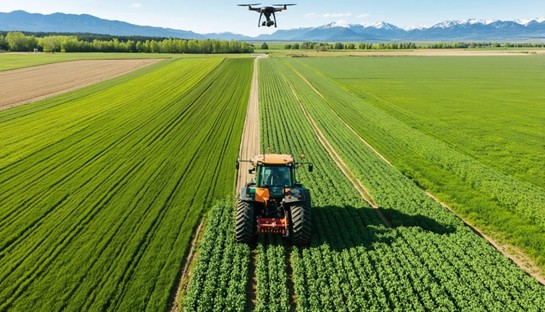
Satellite imagery, via platforms like NASA’s Landsat or ESA’s Sentinel, enables large-scale monitoring. A 2024 study from the University of California, Merced, uses satellite data for evapotranspiration mapping, improving irrigation efficiency by 25%. The University of Alberta (Canada) employs drones and satellites for precision agriculture, reducing over-irrigation in canola fields.
These technologies converge in hybrid systems. For instance, Michigan State University’s projects combine IoT with AI for dynamic scheduling, yielding 15% higher crops. The University of Guelph integrates satellite imagery with ground sensors for vineyard management, saving 28% water.
Challenges include data privacy and high initial costs, but benefits outweigh them. A 2025 MDPI review emphasizes AI-IoT fusion for sustainable farming, predicting widespread adoption by 2030.
Regional Focus: Investments in the USA and Canada
In the USA, farmers and governments are heavily investing in smart irrigation. The California Department of Water Resources reports over 1 million acres under precision systems, supported by USD 100 million in grants. Texas A&M University’s research shows AI reduces water use by 30% in cotton fields.
The Midwest benefits from USDA funding; Iowa State University’s studies on IoT for corn irrigation demonstrate 20% yield increases. In the Pacific Northwest, Oregon State University focuses on satellite-guided systems for orchards, addressing water scarcity.
Canada’s investments are equally robust. Agriculture and Agri-Food Canada’s CAD 185 million for precision agriculture includes smart irrigation. The University of Guelph’s work on AI for soybean irrigation has boosted yields by 12%.
In British Columbia’s Okanagan Valley, the University of British Columbia partners with wineries for IoT systems, reducing water use by 25%. Prairie provinces see investments from the University of Saskatchewan, where satellite imagery optimizes wheat irrigation.
Cross-border collaborations, like the North American Climate Smart Agriculture Alliance, foster innovation. A 2025 Science paper from Michigan State University notes a 450% surge in agricultural UAVs, enhancing satellite data.
Case studies illustrate impact. In California’s Central Valley, UC Davis-led projects use AI-IoT for almond orchards, saving 15% water. In Ontario, Guelph’s drone-based systems for corn fields cut costs by 20%.
Challenges and Future Outlook
Despite growth, challenges persist. High costs deter small farmers; 2025 USDA report notes barriers for operations under 500 acres. Data integration issues and cybersecurity risks are concerns, as highlighted in Purdue University’s research.
In Canada, rural connectivity limits IoT adoption, per University of Alberta studies. Policy gaps, like inconsistent grants, slow progress.
The future is bright. By 2032, AI advancements will enable fully autonomous systems. Satellite constellations like Starlink will improve connectivity. University collaborations will drive innovation, e.g., Cornell’s blockchain for water trading.
North America will lead with 40% market share, per projections. Investments in R&D, like NSF grants in the USA and NSERC in Canada, will accelerate adoption.
Conclusion
Smart irrigation technology is set for rapid growth in North America, driven by scarcity, policies, and innovations. University research from Guelph, Michigan State, and others underscores its potential to transform agriculture. As we face climate challenges, these systems offer a path to resilient, efficient farming. The projected market expansion to USD 4 – 8 billion by 2032 reflects this promise. Stakeholders must invest in accessible, secure technologies to realize this vision.
References
1. MarketsandMarkets. (2025). Smart Irrigation Market Report. marketsandmarkets.com
2. SkyQuest. (2025). Smart Irrigation Market Insights. skyquestt.com
3. Persistence Market Research. (2025). Smart Irrigation Controller Market. persistencemarketresearch.com
4. SNS Insider. (2025). Smart Irrigation Market Report. snsinsider.com
5. P&S Intelligence. (2025). Smart Irrigation Market Forecast. psmarketresearch.com
6. Stellar Market Research. (2025). Smart Irrigation Market. stellarmr.com
7. DataM Intelligence. (2025). Smart Irrigation Market Analysis. datamintelligence.com
8. Consegic Business Intelligence. (2025). Smart Irrigation Market Size. consegicbusinessintelligence.com
9. Intel Market Research. (2025). Smart Sprinkler Irrigation Systems Market. intelmarketresearch.com
10. MDPI. (2025). IoT Sensing for Advanced Irrigation Management. mdpi.com
11. Sensors. (2025). IoT-Based Smart Irrigation Systems. mdpi.com
12. TURJAF. (2025). AI and IoT-Based Smart Irrigation. turjaf.com
13. ResearchGate. (2025). Smart Water Systems: AI and IoT in Precision Irrigation. researchgate.net
14. Wiley. (2025). Application of Precision Agriculture Technologies. onlinelibrary.wiley.com
15. OMICS. (2025). Optimizing Smart Drip Irrigation Systems. omicsonline.org
16. HAL. (2025). Application of Advanced AI Models for Irrigation. hal.science
17. MarketsandMarkets Blog. (2025). Water Conservation and Smart Irrigation. marketsandmarkets.com